ABSTRACT
Objectives
To assess the clinical validity of artificial intelligence (AI)‐driven virtual implant placement compared to human intelligence (HI)‐based virtual and actual single implant placement in the posterior mandible.
Material and Methods
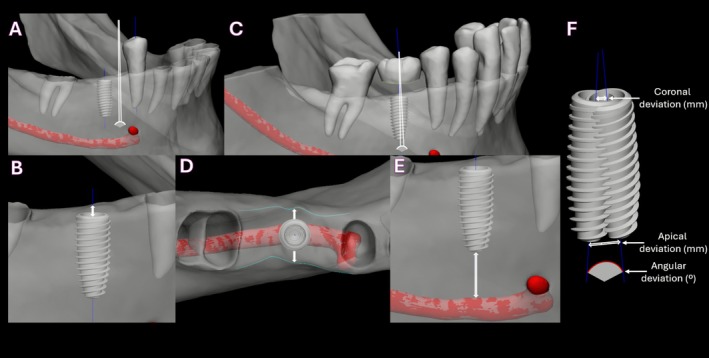
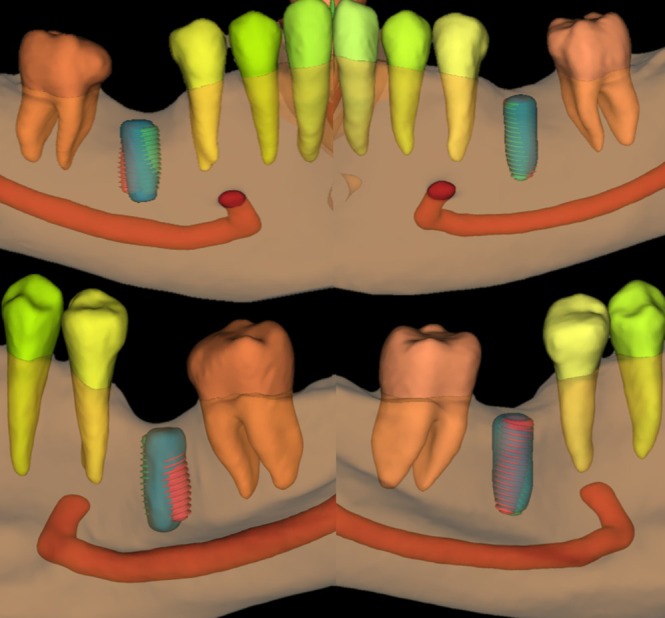
Thirty‐two patients for whom experts performed single implant placement in the posterior mandible were included, each with preoperative and postoperative cone‐beam computed tomography (CBCT) scans. The preoperative scans were registered to the corresponding postoperative scans and used for both AI‐ and HI‐driven virtual implant planning at the implant site. From each case, three implants' scenarios (i.e., HI‐placed, AI‐planned, and HI‐planned) were exported and compared. The analysis focused on angular deviation and the spatial relationship of each implant to adjacent anatomical structures and the expert‐designed prosthetic wax‐up. In addition, pairwise comparisons were performed to quantify angular and linear deviations at both the coronal and apical levels. Implant length and diameter from planned versus placed implants were evaluated, and planning time and consistency were compared between AI‐ and HI‐based approaches.
Results
AI‐based planning showed no statistically significant differences compared to HI‐based methods observed in angular deviation relative to adjacent tooth (HI‐placed: 7.7° ± 5.6°, AI: 6° ± 4.7°, HI‐planned: 5.2° ± 5.7°) and coronal deviation (AI vs. HI‐placed: 0.9 ± 0.8 mm, AI vs. HI‐planned: 0.8 ± 0.4 mm, HI‐planned vs. HI‐placed: 1.0 ± 1.1 mm), all with p > 0.05. Implant diameter and length were also consistent across the different approaches, with HI‐placed (4.3 ± 0.3 mm; 9.7 ± 1.3 mm), AI (4.3 ± 0.4 mm; 9.9 ± 1.2 mm), and HI‐planned (4.3 ± 0.4 mm; 9.8 ± 1.3 mm) showing no significant differences (p > 0.05). However, AI planning was significantly faster (36.3 ± 7.3 s vs. 373 ± 113 s) and more consistent, with a median surface deviation of 0 mm compared to 0.39 mm for HI (p < 0.05).
Conclusion
The AI tool showed clinically valid implant selection, matched expert placement and planning in virtual implant positioning for missing mandibular premolars and molars while being highly consistent and 10 times faster compared to human expert planning.