Objective: To evaluate the generalizability of an artificial intelligence (AI)-based software for automated segmentation of posterior teeth in cone beam CT (CBCT) scans and to identify the variables that influence the need for refinement of automatic segmentations (AS).
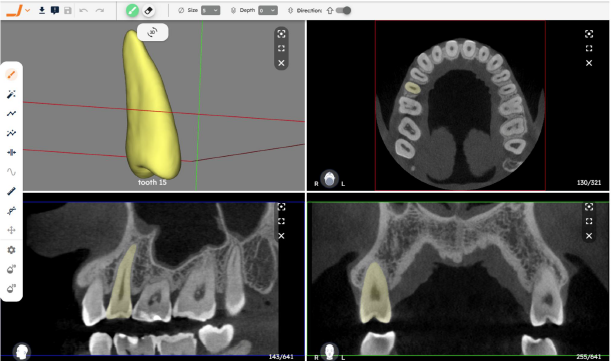
Methods: A total of 190 scans from 190 patients, acquired using 5 CBCT systems were imported into the Virtual Patient Creator (Relu, Leuven, Belgium) for AS. Two dental surgeons qualitatively assessed the segmentations of posterior teeth and refined those requiring correction. Manual segmentation (MS) of 20% of the sample was performed using Mimics software (Materialise, Leuven, Belgium). Performance was analyzed through voxel-by-voxel and surface-based comparisons, in addition to the evaluation of time efficiency. Associations between independent variables and the need for refinement were analyzed using mixed logistic regression (α = 5%).
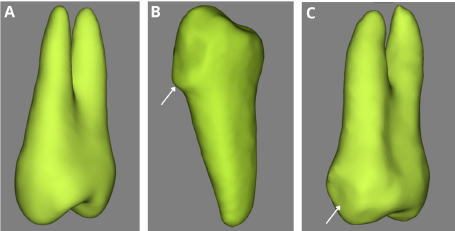
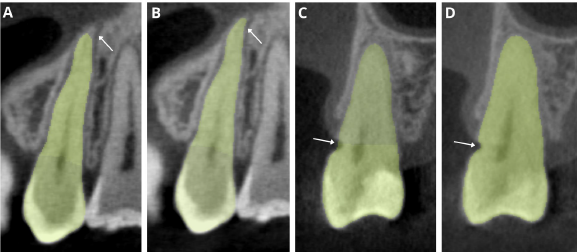
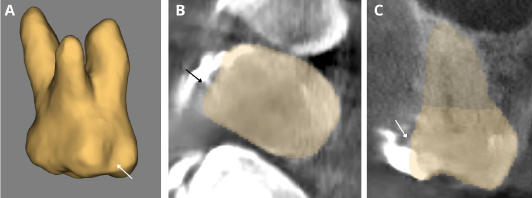
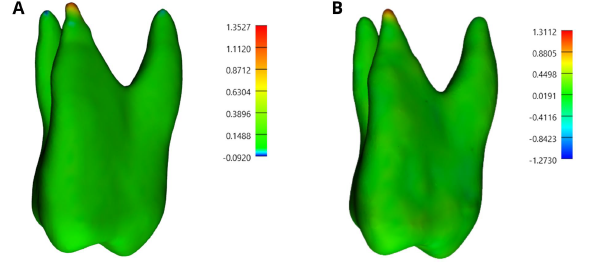
Results: Among the 1005 teeth evaluated, only 12.7% required refinement. Age and the presence of brackets were significant predictors (P<.001). The unexplained variability was attributed mainly to the patients, with minimal influence from the CBCT systems. AS showed agreement with refined segmentations (R-AI) (IoU: 0.93-0.96; DSC: 0.96-0.98; precision: 0.99-1.00; recall: 0.94-0.96; accuracy: 0.98-0.99; MAD: 0.05-0.07; RMSE: 0.06-0.14) and excellent performance compared to MS (IoU: 0.94; DSC: 0.97; precision: 0.98; recall: 0.95; accuracy: 0.98; MAD: 0.05; RMSE: 0.09). AS was more time-efficient (12 [AIQ: 5]) compared to R-AI (202 [AIQ: 334]) and MS (1726 [AIQ: 863]).
Conclusion: The AI-based software demonstrated high accuracy and generalizability for automated segmentation of posterior teeth in CBCT scans.